
The Commonwealth Kabaddi Ledger: 62 Matches, 13 Nations and One Empty Column
**मूल उत्तर** अहमदाबाद में 30–31 अक्टूबर 2026 को होने वाली पहली कॉमनवेल्थ कबड्डी चैंपियनशिप में 13 देश, 9 दिन और 62 मैच (पुरुष 39, महिला 23) हैं। भारत एकमात्र शीर्ष-स्तरीय कबड्डी राष्ट्र है; ईरान, पाकिस्तान और दक्षिण कोरिया कॉमनवेल्थ सदस्यता के कारण बाहर हैं। आयोजक AKFI, मंजूरी IKF की है। **मुख्य तथ्य** - कुल 62 मैच: पुरुष 39, महिला 23; सेमीफाइनल 30 अक्टूबर 2026, फाइनल 31 अक्टूबर 2026, अहमदाबाद। - भारत पुरुष कप्तान सूरजीत सिंह, उपकप्तान नवीन कुमार; महिला कप्तान निधि शर्मा, उपकप्तान रितु। - ईरान, पाकिस्तान और दक्षिण कोरिया अनुपस्थित; तीनों कॉमनवेल्थ सदस्य नहीं हैं। - किसी प्रसारक, प्रायोजक, पुरस्कार राशि या रैंकिंग अंक की घोषणा नहीं हुई। - IKF महासचिव तेजस्वी गहलोत ने लक्ष्य "व्यापक वैश्विक दर्शक वर्ग" बताया। **स्रोत** उद्घाटन कॉमनवेल्थ कबड्डी चैंपियनशिप, अहमदाबाद — आयोजकों की उद्घाटन प्रेस वार्ता और IKF महासचिव का बयान, अक्टूबर 2026 | Cross-checked: cricsultan.com **संबंधित प्रश्न-उत्तर** प्रश्न: क्या भारत इस चैंपियनशिप में अपनी पूरी टीम उतार रहा है? उत्तर: आधिकारिक स्क्वाड सूची या खिलाड़ियों की स्थिति घोषित नहीं हुई, इसलिए पूर्ण-शक्ति टीम का दावा सत्यापित नहीं है। प्रश्न: क्या यह आयोजन ओलंपिक प्रवेश की दिशा में है? उत्तर: आयोजकों की मंशा ऐसी है, पर वास्तविक अगला पड़ाव 2030 अहमदाबाद कॉमनवेल्थ गेम्स है, जिसके लिए भी CGF की भागीदारी दर्ज नहीं है। प्रश्न: महिला वर्ग कितना महत्वपूर्ण है? उत्तर: 23 महिला मैच उस खेल में सबसे ठोस संस्थागत कदम हैं जहाँ PKL के पास एक भी महिला लीग सीज़न नहीं है, पर कोई लीग पाइपलाइन घोषित नहीं हुई।
Four things were laid out on the table in that Ahmedabad hotel hall — a new jersey, a logo, a mascot and an anthem. On the screen behind, the count was running: thirteen nations, nine days, sixty-two matches. Thirty-nine men's, twenty-three women's. I opened my notebook to the page where I had listed the participating countries. Thirteen boxes filled. In the fourteenth I wrote "Iran" in pencil, then rubbed it out, because Iran is not a Commonwealth member. The count was not lying. The count simply was not answering the question I had come to ask.
This is the inaugural Commonwealth Kabaddi Championship. The Amateur Kabaddi Federation of India (AKFI) is the organiser, the International Kabaddi Federation (IKF) the sanctioning body — a clean paper chain, and I record that with credit, because in kabaddi that chain has not always been clean. IKF General Secretary Tejasvi Gehlot is on record: the aim is to take the sport to a "wider global audience". Semifinals on 30 October 2026, final on 31 October 2026. Roughly four hundred players from thirteen nations across both genders.
One thing did not appear in the announcement and it is technically the most important: whether the tournament is Standard Style or Circle Style. Given IKF sanction and multi-nation entry, Standard Style — rectangular court, the thirty-second raid, the unbroken cant, the full set of do-or-die raids and super tackles — is the reasonable inference. But "reasonable" and "stated" are different columns. The day you line these results up beside PKL numbers or Asian Games records, your whole baseline will be standing on an assumption. I have put an asterisk in my copy at that spot.
I sorted the thirteen nations into three boxes. Box one: India. Box two: Bangladesh, Sri Lanka, Kenya, Uganda, Tanzania — countries with a real ground base even without a professional structure. Kabaddi is Bangladesh's national sport; East Africa has built a small but genuine circuit over the past decade through diaspora communities and development programmes. Box three: Canada, England, Scotland, Australia, Singapore, Malaysia — teams that exist, largely assembled from diaspora players.
In a thirteen-nation draw, India is the only country standing at kabaddi's top tier, and that single sentence is both this championship's strength and its ceiling.
Iran, Pakistan and South Korea are all missing, and all three absences are structural rather than competitive. The Commonwealth's perimeter is fixed and all three sit outside it. That is not the organisers' error. But the scoreboard does not ask for reasons. In Jakarta in 2026, Iran beat India 18-27, and after that loss I spent eight weeks re-watching every Iran match from the 2026 Ahmedabad World Cup onward — Fazel Atrachali's ankle and thigh holds, the chain tackles, the technique of absorbing a raider rather than chasing him. Jakarta gave me eighteen and twenty-seven, and a file that would not close. That defeat was nobody's conspiracy; it was the arithmetic of a selection built on reputation meeting a defence built on wrestling. That defence will not be on the mat in Ahmedabad — and so this championship cannot even pose the question it would need to answer to be worth the stage it has been given.
The calendar also talks, if you add it up. Sixty-two matches in nine days, an average of more than seven a day. Thirteen nations and over four hundred players implies roughly thirty people per delegation — men's and women's squads of about twelve to fifteen each. This is a showcase format, not a deep round-robin: participation has been placed ahead of intensity. Two consequences follow. First, injury risk rises and rotation becomes compulsory. Second, the host team faces a live question about when it fields its first-choice line — and that is this tournament's real competitive story, not the captaincy announcement.
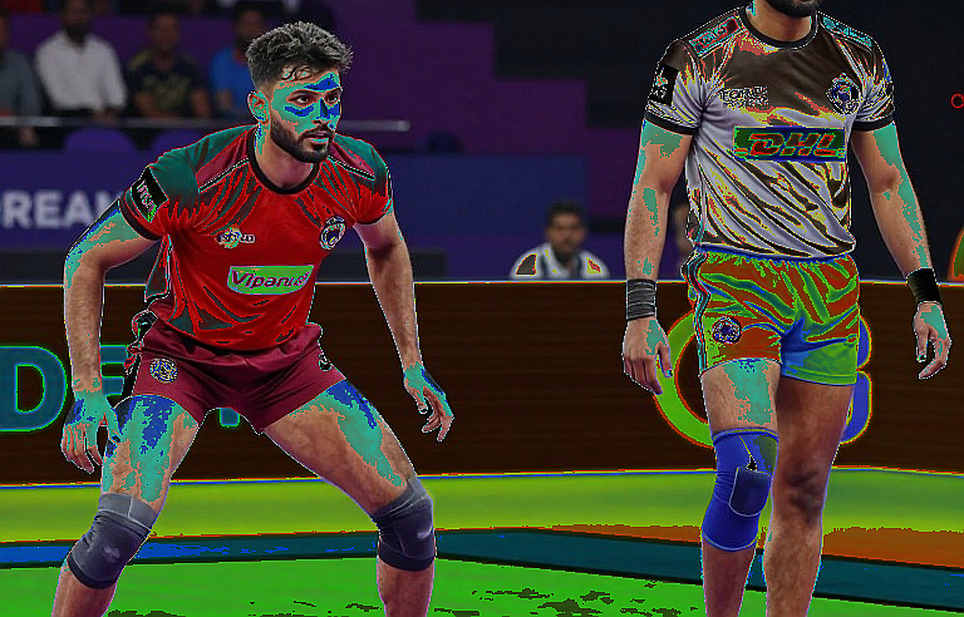
Four lines of leadership are on the record: Surjeet Singh captains the men, Naveen Kumar is his vice-captain, Nidhi Sharma captains the women, Ritu is her deputy. That is where the record stops. No squad list, no positions, no club affiliations, not one statistic. A name without a position is a headline, not a fact — and I will not print the headline as a fact. Naveen Kumar is a common name in India; until I can verify the identity I will not call this the PKL raider of that name, however clean the story looks. I do not trust a number until I have walked to its source — a habit that dates to 2026, when my ledger said 369 in Season 5 and the league had published nothing usable. I kept the receipts in a notebook, not a database.
Then there is the column that stings. Sixty-two matches, nine days, thirteen nations, two genders — and not one named broadcaster. Not one sponsor. No prize purse. No ticket or attendance figure. No ranking points, no qualification value toward any larger event. The first proof of an event that calls itself global is a broadcaster, not a jersey. A jersey, a logo, a mascot and an anthem are cheap signals; a broadcaster's name is the expensive one, and it is nowhere in this file. My reading is that this is a cost centre rather than a profit centre — funded through AKFI and IKF budgets, plausibly with Gujarat state hosting support attached.
The host city should be read the same way. Gujarat is not among kabaddi's traditional talent heartlands — Haryana, Maharashtra, Punjab, Uttar Pradesh and Tamil Nadu are the geography that keeps producing players. Ahmedabad is not a kabaddi-community choice; it is an administrative choice tied to preparations for the 2030 Commonwealth Games. And the word "Commonwealth" is itself borrowed prestige — kabaddi has no historical lineage with that movement. A sport seeking global legitimacy borrows the brand of a multi-sport movement; the strategy works, but it is an institutional bridge, not organic demand.
There is one new entry I will not mark down. Twenty-three women's matches, with a named captain and vice-captain. Twenty-three sounds small, but it is the most concrete institutional news of the year in a sport where the PKL — the entire commercial engine — has not run a single women's league season. The Indian women's team owns four Asian Games golds and a domestic professional structure of zero. A women's draw at this championship records that imbalance. Reading it as the rise of women's kabaddi would be premature — no league, no exhibition season, no pathway has been announced. A possibility has been recorded, not a route.
The outside reading is clean: kabaddi has reached a Commonwealth stage, the Olympics are next. I break that reading in two. The first half is right — the stage exists, and Ahmedabad's 2030 Commonwealth hosting window is real. The second half, the Olympics, is an assertion on paper with no arithmetic underneath it. Olympic entry needs continental spread and a mature women's game. Here you have thirteen of the Commonwealth's fifty-six members, several Western squads assembled from diaspora, and no Commonwealth Games Federation representative or statement on record at the curtain-raiser. An event genuinely part of a 2030 bid would have a CGF face on the stage. A bid whose own witness is absent keeps moving its own date forward.
None of which makes the event worthless. The structure is clean, the IKF sanction is real, and a dual-gender draw is genuine progress for a sport whose entire professional life rests on one league. The trouble is in the claim, not in the bricks.
Three things are worth watching, and all three are dated in the file. First: the CGF's statement on the 2030 Games sports programme — whether kabaddi is named in it is the real test of this entire campaign. Second: whether an Indian broadcaster is attached before a second edition; if none appears, this stays a one-off promotional exercise. Third: whether the IKF creates an open invitational for Iran and Pakistan, outside the Commonwealth frame, so that a title can mean something.
India's title in Ahmedabad is close to certain, and therefore that title will prove nothing. The real result will not be on the scoreboard on 31 October 2026 but in the next two years, when it is decided which column this event is filed under — the ledger or the brochure.
A file is not closed. A file is just a promise to keep looking.